
By CHANGE OF GUARDS
Museveni's Brig. Michael Bossa died last week. The regime claimed he had died of COVID-19 but he was a known asthmatic. The Born-Again, humble original Muganda was Makerere University graduate of Telecommunications Engineering. He joined the army after the NRA had captured power in 1986. Like many others who were shy to directly enlist in the military service, but were conditioned to undergo the political indoctrination sessions in order to access jobs, Brig. Bossa was among the first intake of the NRM Political School at Namugongo in 1986. Under the leadership of Museveni's notorious Maj. Kakoza Mutale, the school that had been set up deep in the forest was mistaken for a rebel camp and attacked by another NRA unit. Several were killed while others were injured but the matter was, as usual, swept under the carpet with no one being held to account for the uncalled for ugly incident.
Engineer Michael Bossa was deployed to the President's Office from where he ended up being compelled to become a soldier under the Directorate of Military Intelligence (DMI) headquarters at Basiima House. That kind of indirect recruitment into the army was one if the ways of entrapping intellectuals and the professionals into military service. Many others ended in the army in a similar way; Brig. Felix Kulaigye was a MchakaMchaka trainee at Kyankwanzi long after the NRA had captured power but he now claims to know the NRA more than Brig. Kanyankole did.
Eng. Bossa received went for a short intelligence training course in Russia before he pioneered being the de facto head of the Technical Department at DMI. At the time, the Technical department was only preoccupied with tapping of landline telephone lines, secret recordings of targets and other simple technical undertakings. In some instances, his expertise would be utilized in procurement of communication equipment for the army. Being a Telecommunications Engineer, Bossa was the sole brain in this endeavor. At the rank of Sgt, he worked under Col. Byemaro Mijumbi and for a very short period under Paul Kagame (current President of Rwanda) who held the position of Assistant Director, Technical. When Col. Byemaro became the DMI and Paulo Kagame headed for a course in the USA, Sgt. Bossa assumed the position of Assistant Director, Technical. At the time, he was the only Non Commissioned Officer (NCO) to hold the position of Assistant Director under DMI.
Around the early 1990s, Sgt. Bossa was automatically commissioned to the rank of Lieutenant and continued to head the Technical Department at DMI. He married a one Jovanice who had since 1986 been the only civilian Secretary at DMI. She is a sister to the former Bukanga M.P, Nathan Byanyima. With the diplomatic fallout with Rwanda of the early 2000s, all those who had served under DMI when it was dominated by Rwandans were subjected to scrutiny. Bossa and his wife Jovanice were removed from DMI and sent languishing at the army headquarters in Bombo. With CMI assuming more of the civil intelligence role coupled by rapid information technology advancements, Engineer Bossa resumed his position at CMI. He must have been the brain behind CMI's rigorous technical surveillance scheme. In the same regard, in June 2016 he was moved from CMI and taken to the army headquarters as Chief of Communications and Information Technology. (CCIT).
Bossa was the brain behind Museveni's grand surveillance scheme which was unearthed in October 2015. In a report released by the BBC, it was alleged that the regime had acquired sophisticated high-tech spy gadgets worth Shillings 300 billion from Europe. The same report further revealed that Museveni's CMI was the only agency in the procurement and utilisation of the said gadgets under an operation codenamed "Fungua Macho" (Kiswahili for 'open eyes'). Using intrusive malware to infect the electronic communication devices, the scheme targeted top opposition activists, the media and other dissenting voices.
INFORMATION IS POWER AND THE PROBLEM OF UGANDA IS MUSEVENISM
===
OPERATION FUNGUA MACHO
https://www.bbc.com/news/uk-34529237
By Nick Hopkins and Jake Morris
BBC Newsnight
Published 15 October 2015
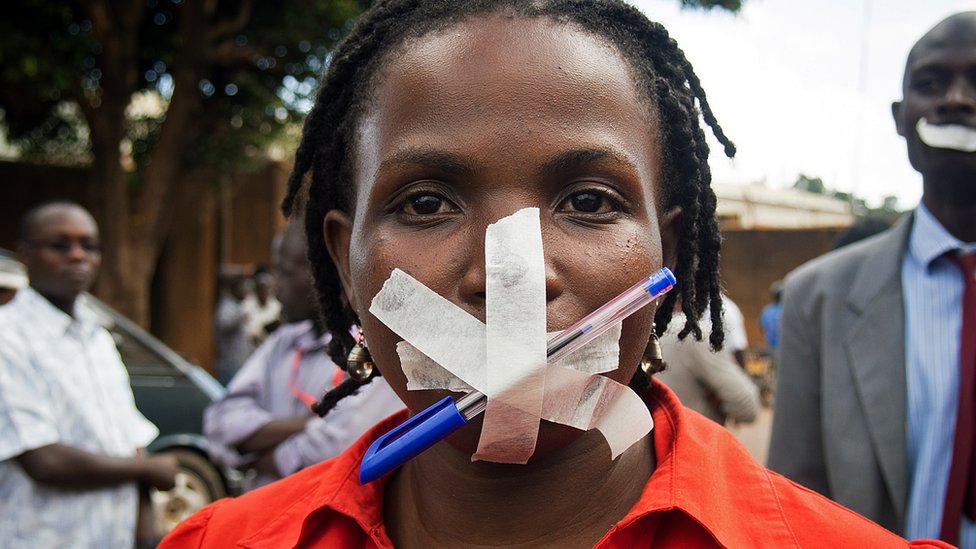
A UK-based firm has sold surveillance technology to Uganda which has been used to crush and potentially blackmail opponents of the president, according to documents seen by BBC Newsnight.
An internal report claims the technology has also been used in other African countries and in Syria.
The Ugandan government denies the operation exists.
The firm, Gamma Group, says it does not assist or encourage any government agency in the misuse of its products.
Technology companies are duty bound not to sell "off-the-shelf" systems to countries if they have any concerns about how they will be used.
Surveillance systems are not regulated in the same way as arms equipment, an anomaly that has raised concerns among MPs and human rights groups. They fear the technology can be used for internal repression.
Codename Fungua Macho
The BBC has been working with Privacy International, who were leaked a top secret memo and other documents purportedly detailing the use of the technology for the use of internal repression in Uganda.
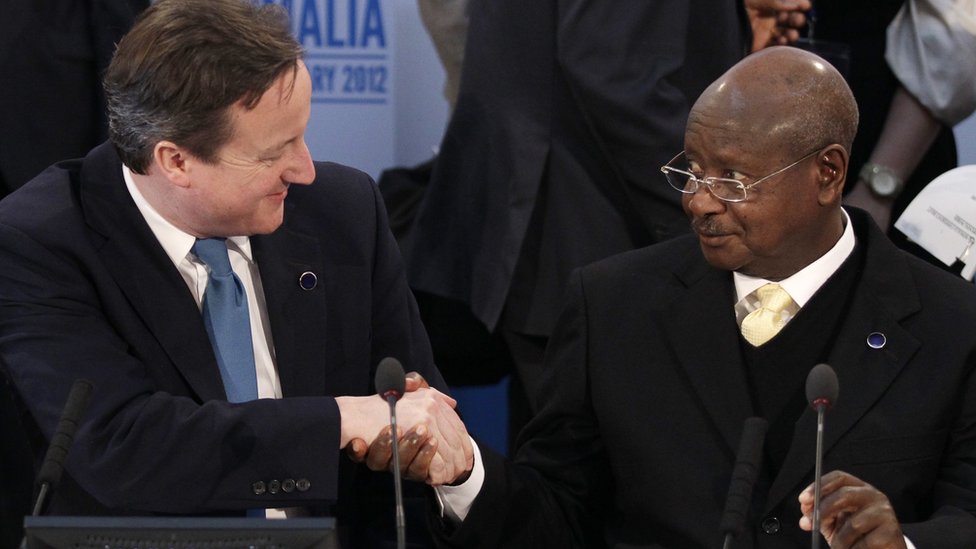
One top secret document was prepared by a senior intelligence official for President Museveni and describes a surveillance programme codenamed Fungua Macho, which involved more than 70 intelligence analysts.
Dated January 2012, the document says the Finfisher technology bought from Gamma Group International has been used "to spy on the enemy, collect data, intrude enemy systems, intercept enemy communication and also manipulate transmissions.
"It can covertly be deployed in buildings, vehicles, computers, mobile phones, cameras and any other equipment deemed worthy for information extraction or surveillance."
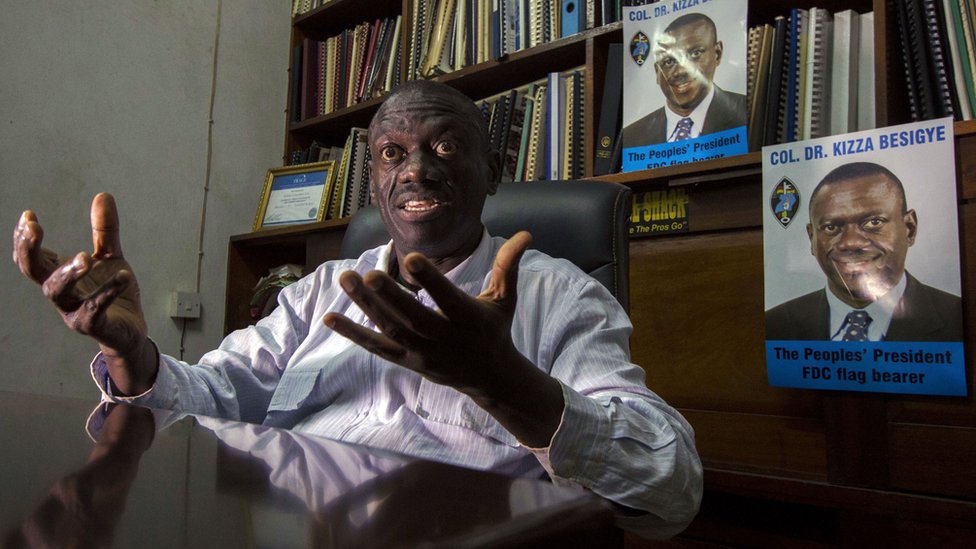
The document says the operation has already gathered "hordes of information revealing secret plans" of the main Ugandan opposition party, the FDC.
It says the aim of the operation is to "to manage and control the media houses and opposition politicians.... which... may involve blackmailing them."
"I am glad to inform you that since we started we have managed to collect substantial amount of information from different targets... people deemed dangerous to state security like government officials and opposition politicians are being surveilled."
The document says the technology "is being used by countries like Nigeria, Rwanda, Zimbabwe, Senegal and most recently Kenya. It is also the main tool that has been employed by the Syrian government; although it came a little too late when the demos were out of hand but has to a greater extent managed to contain the situation."
'No evidence' says government
The BBC asked the Ugandan government to give details of its surveillance operations and explain why it was targeting opposition politicians.
Government spokesman Colonel Shaban Bantariza told Newsnight: "I am not aware of an order having been given or having been authorised to surveil anybody so those who are making that allegation, the onus is on them to prove it that they are being surveilled - that their phones are being tapped. When did they do that? What did they tap? What did they cause? So the onus is on those who are alleging to prove - we have no evidence they are being surveilled."
The Ugandan government, which received £1bn in UK aid and investment last year, did not respond to follow up questions about the surveillance programme.
However, in a letter to Privacy International, a Ugandan government spokesman denied the operation existed.
"President Museveni does not use criminal blackmail as a political tool to win over or deal with opponents... it does not add any value as (the) government enjoys broad political legitimacy and support."
Gamma Group International is a British-based company with affiliates in a number of countries, including Germany. It says it sells surveillance technology to governments for counterterrorism purposes.
In a statement, the company said it was unable to to give details of any alleged orders.
"Gamma undertakes an absolute obligation of confidentiality to the governments which purchase its products and systems.
"Gamma does not assist or encourage any government agency in the misuse of Gamma's products and systems.
"These products and systems have been effective in many countries in the course of police and other government agency action against terrorist threats, drug cartels, other major organised crime, and paedophile rings."
Gamma Group said it has a human rights policy, but declined to share a copy of it.
Gus Hosein, director of Privacy International, said: "The documents say that the surveillance industry will sell to just about anyone. And it is proof of the fact that we have been trying to raise all along - that these technologies are far too powerful to be in the hands of governments and that governments will go ahead and abuse them."
Last year Gamma was criticised in a ruling by the UK National Contact Point for the Organisation of Economic Cooperation and Development. The OECD said the company's approach to selling technology was "not consistent with the general obligations to respect human rights".
Nick Hopkins' full report ran on BBC Newsnight on Thursday 15 October. You can catch up on iPlayer
Update 29 January 2016: The Ugandan government was given 13 days to respond to detailed questions from the BBC about its surveillance programmes before this story was published and did not do so. Since then, the Ugandan government has denied in public, and later in correspondence with the BBC, that it is spying on opposition politicians. It says the documents leaked to Privacy International that purport to set out such activity are fakes.
Gamma says there are inconsistencies in the report around dates and it claims the signatures in the report differ from those in other documents subsequently provided to it by the Ugandan government.
However, the Ugandan government has confirmed that it met representatives from Gamma over a number of days in 2012 and in 2013, but it insists it did not buy any equipment from the firm. The Ugandan government told the BBC: "The government of Uganda wishes to emphasise that the political opposition is Uganda is not an enemy, perceived or otherwise."Gamma says it cannot confirm or deny any dealings with customers.
A spokesman for Privacy International said it stood by the report: "The Ugandan government has in numerous instances alleged that documents have been forged when information unfavourable to it has been made public."
For the avoidance of doubt, we'd like to make clear that a company with a similar name, Gamma Communications, is not related to Gamma Group International - and is in no way involved in this story.
===
PRIVACY INTERNATIONAL'S 80 PAGE REPORT
https://privacyinternational.org/sites/default/files/2017-12/Uganda_Report_1.pdf

No comments:
Post a Comment
Note: only a member of this blog may post a comment.